If you've ever looked into whole-home humidifiers, you've probably come across two options: bypass humidifiers and steam humidifiers. Both do the same basic job of adding moisture to the air in your home, but they work very differently and are better suited to different situations. Here's what you need to know before deciding which one is the right fit.
Why whole-home humidity control matters
During New Hampshire winters, the air inside your home gets extremely dry. That dryness shows up in a lot of ways:
- Static electricity
- Cracked woodwork
- Dry skin and irritated sinuses
- Increased susceptibility to illness
A whole-home humidifier connects directly to your HVAC system and treats every room at once, unlike a portable unit that only addresses one space at a time. Both bypass and steam humidifiers work only on forced-air systems, meaning you need a furnace and ductwork for either to function.
How a bypass humidifier works
A bypass humidifier attaches to your ductwork near the furnace. Inside, there's a water panel that looks a bit like a honeycomb. Water trickles down over the panel, warm air from the furnace passes across it, picks up the moisture, and carries it into your home through the ductwork.
The upside:
- More affordable upfront and inexpensive to operate
- Simple to install
- Does a great job in average-sized homes
The limitation: A bypass humidifier relies on your furnace being active to create humidity. If the thermostat isn't calling for heat, the humidifier isn't doing much.
How a steam humidifier works
A steam humidifier has its own built-in steam generator. It heats water independently, produces steam, and injects it directly into your ductwork. Your furnace blower then circulates that humid air throughout the home.
The upside:
- Doesn't need the furnace to be running to do its job
- More consistent and controllable humidity year-round
- Better suited to larger homes that need higher moisture output
The limitation: Steam humidifiers cost more upfront and carry higher monthly operating costs since they generate their own heat. For many homeowners, the added control is worth it.
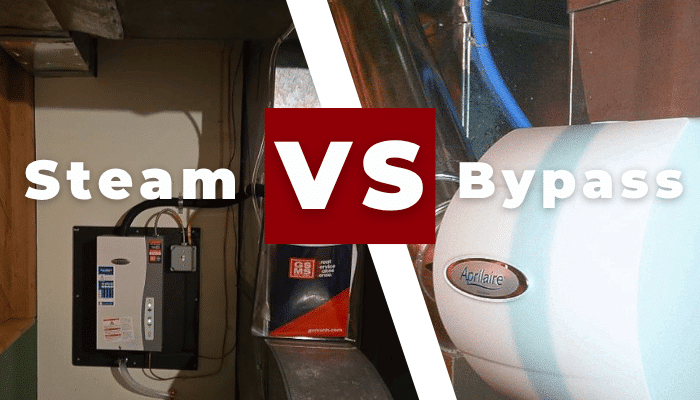
Steam vs Bypass Humidifiers
| Category | Bypass | Steam |
|---|---|---|
| Upfront cost | Lower | Higher |
| Operating cost | Lower | Higher |
| Works without heat running | No | Yes |
| Best for | Average-sized homes | Larger homes or homes needing precise humidity control |
| Humidity consistency | Good | Excellent |
So which one should you choose?
A bypass humidifier is a great fit if you:
- Have an average-sized home
- Want a straightforward, affordable solution
- You are comfortable with humidity being tied to your heating cycle
A steam humidifier makes more sense if you:
- Have a larger home that needs consistent humidity throughout
- Want humidity control that operates independently of your heating system
- Have struggled to maintain comfortable humidity levels in the past
The best way to know for sure is to have a Service Specialist evaluate your home and existing system. Humidifier sizing matters just as much as which type you choose, and getting that right from the start will save you a lot of frustration down the road.
Questions about humidity control in your New Hampshire home?
At GSMS, our Service Specialists have been helping New Hampshire homeowners stay comfortable through the winter for nearly four decades. If you're not sure which humidifier is the right fit for your home, give us a call at 603-424-8258 or contact us here, and we'll help you figure it out.