
It's Not Broken. Here's What's Actually Happening — And What to Do About It.
If you've ever woken up to a frigid New Hampshire morning and wondered why your thermostat says 65°F when you set it to 68°F, you're not alone, and your furnace isn't broken. Here's what's actually going on, and what you can do to protect your home when the deep freeze hits.
It's Not a Malfunction. It's Physics
When temperatures plunge into the single digits or below zero, even a perfectly functioning furnace can fall behind. The reason comes down to how heating systems are designed in the first place.
Heating contractors use the ACCA Manual J to size furnaces for homes. This calculation is based on a "design condition" — essentially, the coldest temperature the system is built to handle comfortably. For most of New Hampshire, that standard design temperature is 7°F. That means a properly sized furnace is engineered to maintain your desired indoor temperature when it's 7 degrees outside — but only just barely.
When the thermometer drops below that threshold, the furnace simply can't remove heat loss from your home fast enough. It's not failing — it's just being asked to do more than it was designed for.
At GSMS, we've adjusted our design standard to 0°F to account for the increasingly extreme winters we're seeing across New Hampshire. That means the systems we install have a bit more built-in capacity for the brutal nights. But even so, when temperatures go dangerously sub-zero, every system has its limits.
What to Expect During a Deep Freeze
Your furnace will run continuously. This is normal. During extreme cold, your system will operate 24/7 — that's it doing exactly what it's supposed to do. A furnace that cycles on and off normally during mild weather will stay on for hours straight when it's -10°F outside.
Your indoor temperature may drop a few degrees. Even running non-stop, your furnace may not be able to fully match the heat escaping through your walls, windows, and roof. Dropping 2–3 degrees below your set point is expected and not cause for alarm.
It will not last forever. Once the storm passes and temperatures rise again, your system will recover. Patience — and preparation — are your best tools.
The GSMS "Battle Plan" for Extreme Cold
When a serious winter storm is on the way, here's what we advise our clients to do:
- Bump your thermostat up now — before the worst hits. Raise your thermostat 2–3 degrees before temperatures bottom out. This gives your system a head start rather than trying to play catch-up during the coldest hours.
- Don't do nighttime setbacks during a storm. At GSMS, we recommend finding the temperature that keeps your home comfortable and setting it and forgetting it. Modern systems are designed to adapt on their own, so no manual adjustments are needed. Older systems don't have that flexibility, making consistency even more important — sudden drops are harder to recover from when it's brutally cold outside. The U.S. Department of Energy also warns that letting indoor temperatures drop too low puts your pipes at serious risk, and by morning, your furnace may be fighting an uphill battle to catch up.
- Protect your pipes proactively. Open kitchen and bathroom cabinet doors to let warm air circulate around pipes that run along exterior walls. If you have a drafty room or garage, keep the doors open or use a space heater safely to prevent pipes from freezing.
- Check your air filter. This one is easy to overlook, but it matters the most during extremely cold winters. When your furnace is running non-stop to keep up with sub-zero temperatures, it's moving a tremendous amount of air, and a clogged filter can choke that airflow right when you need it most. If the filter is dirty enough to restrict airflow, your furnace can overheat and trip what's called a "high limit" safety shutoff. It'll cool down and restart, but if this keeps happening, the filter — or a broader airflow issue — is likely the culprit. A quick filter check before a storm could save you a cold night and an emergency service call.
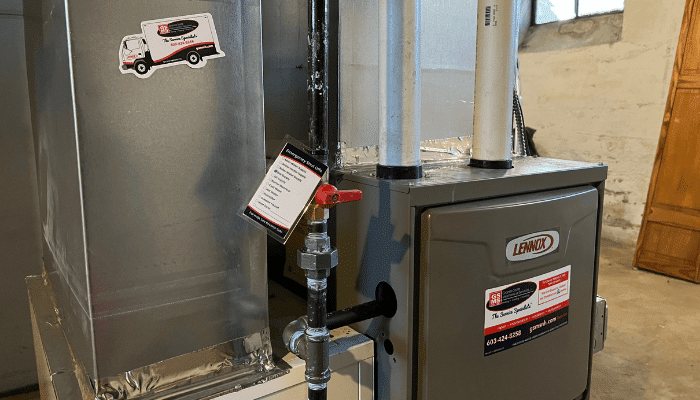
- Check your exhaust vents — this one is critical. High-efficiency furnaces and water heaters vent through white PVC pipes on the side of your house. During heavy snow, drifts can completely bury these pipes. If that happens, your furnace will shut itself down as a safety measure — and you'll wake up to a very cold house.
Every time you go outside to shovel, take a quick look at those pipes and make sure they're clear. It takes ten seconds and could save you an emergency service call.
When Should You Actually Worry?
There's a difference between a furnace that's working hard and a furnace that's in trouble. Call us if:
- Your system shuts off entirely and won't restart
- You smell gas or burning
- There's frost or ice forming on the exhaust pipes rather than just snow buildup
- Temperatures inside drop dramatically (more than 5–6 degrees) even before the storm peaks
Otherwise, trust your system to do its job — and trust the preparation steps above to give it the best chance of success.
The Bottom Line
New Hampshire winters are tough, and the coldest nights will always push your heating system to its limits. That's not a design flaw — it's just the reality of living in the Granite State. The key is knowing what to expect, preparing ahead of a storm, and keeping a close eye on a few critical things (like those exhaust vents) that can make a huge difference.
If you have concerns about whether your system is properly sized for your home, or if you want a seasonal tune-up before the next cold snap, the GSMS team is here to help. We've been keeping New Hampshire homes warm since 1987 — and we know a thing or two about brutal winters.
Call us at 603-424-8258 or Request Service online.