Quick answer:
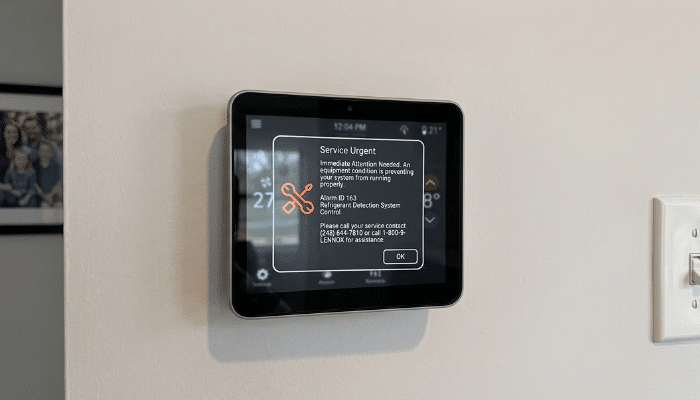
A Lennox thermostat A2L sensor fault code, often shown as Alarm ID 163, means the system's Refrigerant Detection System (RDS) sensed a change in the air and safely paused the equipment to protect your home. It can be a harmless nuisance trip from household fumes, a real refrigerant leak, or occasionally a faulty sensor. Because you cannot tell which from the thermostat, the safe fix is to have a licensed Specialist confirm it with a leak search before running the system again.
If you own one of the newest Lennox systems, you may run into a fault code you have never seen before: the A2L sensor code on your thermostat. Before you worry, here is the good news. It does not mean your system is broken. It means a brand new safety feature is doing exactly what it was built to do.
The HVAC industry recently moved to A2L refrigerant, the latest eco-friendly standard. To go above and beyond safety regulations, Lennox equipped these new systems with state-of-the-art, ultra-sensitive detection sensors. If a sensor notices a change in the air near the equipment, the system pauses itself and runs the blower to keep everything safe.
What to do if your Lennox thermostat shows the A2L sensor code
- Stay calm. In most cases, the code is the safety system doing its job, not an emergency.
- Give the area fresh air. If it is safe to do so, open a nearby window and avoid open flames, candles, or anything that sparks near the equipment.
- If the code clears on its own once the air clears and does not come back, it was most likely something harmless in the air. If it returns even once, stop there and do not keep resetting it.
- Call your Lennox Specialists at GSMS. We will run a quick leak search to confirm whether it was a nuisance trip, a real leak, or a faulty sensor, usually in a single visit.
What a Lennox A2L sensor code really means
On a Lennox thermostat, this typically shows up as Alarm ID 163, the code tied to the Refrigerant Detection System. There are really three things that can set it off: something harmless in the air, an actual refrigerant leak, or, once in a while, a faulty sensor. Because these sensors are so sensitive, they can react to everyday things like aerosol sprays, strong cleaning products, fresh paint, or the fumes that come off new flooring and furniture. When that happens, you may see the fault code even though nothing is wrong with your system. The industry calls this a nuisance trip. It is not a defect, and it does not mean your Lennox heating and cooling system is unreliable. In fact, most of the time it turns out to be nothing.
Here is the part that matters most. From your thermostat, a harmless nuisance trip and a genuine refrigerant leak look exactly the same. There is no way to tell them apart just from the code. That is why, even though the odds are good that it is nothing, the safe fix is always to have one of our Specialists confirm it. A quick check protects your home, and most of the time it simply puts your mind at ease.
What the A2L sensor is for
The A2L sensor is a safety device, not a comfort feature. A2L refrigerants are slightly flammable, so current safety codes require these systems to include leak detection. On Lennox equipment, this is handled by the Refrigerant Detection System (RDS). When the RDS senses refrigerant near the equipment, it stops heating or cooling and runs the blower to help dilute and clear anything that may have collected. In other words, the shutdown is not a malfunction. It is the safety system stepping in on purpose. It is also why the detection cannot simply be switched off: disabling it is not allowed under safety codes, and it is there to protect your family.
Why the code sometimes appears when nothing is wrong
This first generation of A2L sensors is excellent at detecting refrigerant, but it can also pick up other fumes in the air. The most common harmless triggers include: aerosol sprays and hairspray, strong cleaning products and solvents, fresh paint, and off-gassing from new flooring, carpet, or furniture. Newly built or recently renovated homes tend to see nuisance trips more often, because those fumes can linger for weeks.
A few simple habits can lower the odds of a nuisance trip:
- Keep aerosols, solvents, and strong chemicals away from the indoor unit.
- Open a window or run a fan when you paint or clean near the equipment.
- Give new flooring, carpet, or furniture time to air out.
Nuisance trip or real leak? Why you cannot tell at home
| What you might notice | Could be a nuisance trip | Could be a real leak |
|---|---|---|
| The code cleared and has not come back | Often true once fumes clear | A slow leak can also go quiet for hours or days |
| The code keeps coming back | Possible if a fume source is still nearby | Very possible with an ongoing leak |
| You recently painted, cleaned, or installed flooring | A likely cause | A leak can happen at the same time, and the sensor cannot tell them apart |
| You hear a faint hiss or see an oily film near the indoor coil | Unlikely | A common sign of a real refrigerant leak |
| Nothing in your home seems unusual | Feels like a false alarm | The only way to know for sure is a professional leak check |
The bottom line: only a licensed Specialist with the right tools can confirm which one it is, and sometimes the answer is a faulty sensor rather than a leak at all. That is why we never recommend repeatedly clearing the code on your own.
How our Specialists confirm what is going on
When you call us about an A2L sensor code, we run a standard leak search. First, we use a specialized tool that sniffs the air around the equipment for refrigerant, which tells us right away whether any is actually escaping. We also check your system's refrigerant levels to make sure it is performing the way it should. And because the sensor is an electronic part like anything else in your home, we test the sensor itself, since once in a while it is simply faulty and reading a leak that is not there.
Those few checks tell us exactly what we are dealing with: a harmless nuisance trip, a real leak that needs a repair, or a sensor that needs replacing. It is not something you can confirm from the thermostat, but it is quick for us to pin down, and it means you get a real answer instead of a guess.
Is this getting better over time?
Yes. This technology keeps improving. Across the industry, the next generation of A2L sensors is in development, and some manufacturers are adding software timers that help reduce nuisance trips while keeping the safety protection fully in place. If Lennox releases an update for your system, our team can let you know.
Why New Hampshire homeowners trust GSMS with their Lennox systems
As a Lennox Premier Dealer serving New Hampshire since 1987, our Specialists know these new A2L systems inside and out. If a fault code pops up on your thermostat, we will get you a clear answer quickly, so you are never left guessing about your comfort or your family's safety. That is the kind of straight answer and neighborly service we have built our name on.
Seeing an A2L sensor code on your Lennox thermostat? Contact GSMS or call 603-424-8258 , and we will confirm what is going on, usually in one quick visit.
GSMS Home Club members get priority scheduling and extra peace of mind for exactly these moments. If you are not a member yet, the Home Club is worth a look.
Frequently asked questions
It means your system's Refrigerant Detection System sensed a change in the air and safely paused the equipment. It can be a harmless nuisance trip or a real leak, so it should be verified before you keep running the system.
The code itself is a safety feature working as intended. What matters is the cause. Because a nuisance trip and a real leak look the same from the thermostat, the safe step is to have it checked.
The code sometimes clears once the air around the sensor is clear, but that does not tell you what set it off. Repeatedly clearing it can mean running the system with an unaddressed leak, so we recommend a quick professional check instead.
We run a leak search using a specialized tool that sniffs for refrigerant, confirm the system's refrigerant levels, and test the sensor itself. Those checks tell us whether it is a nuisance trip, a real leak, or a faulty sensor, which is not something you can determine from the thermostat.
These sensors are very sensitive and can react to fumes from cleaning products, paint, or new flooring. That is a common and harmless cause, but it is still worth confirming.
No. Leak detection is required on all A2L systems, not just Lennox. The occasional nuisance trip is a side effect of extra-sensitive safety detection, and manufacturers are actively refining it.